Biography of the Cardinal François-Xavier Nguyễn Văn Thuận
A cardinal of the Holy Roman Church, his mission was characterised by intense pastoral and social activity, which was only partially interrupted during his long imprisonment. The conditions in which the prisoners were forced to live were inhumane, but he fought not to fall into despair, clinging to the Word of God and the Eucharist.
His words were authenticated by a serene, sober, and humble life, open to dialogue with other cultures and religions
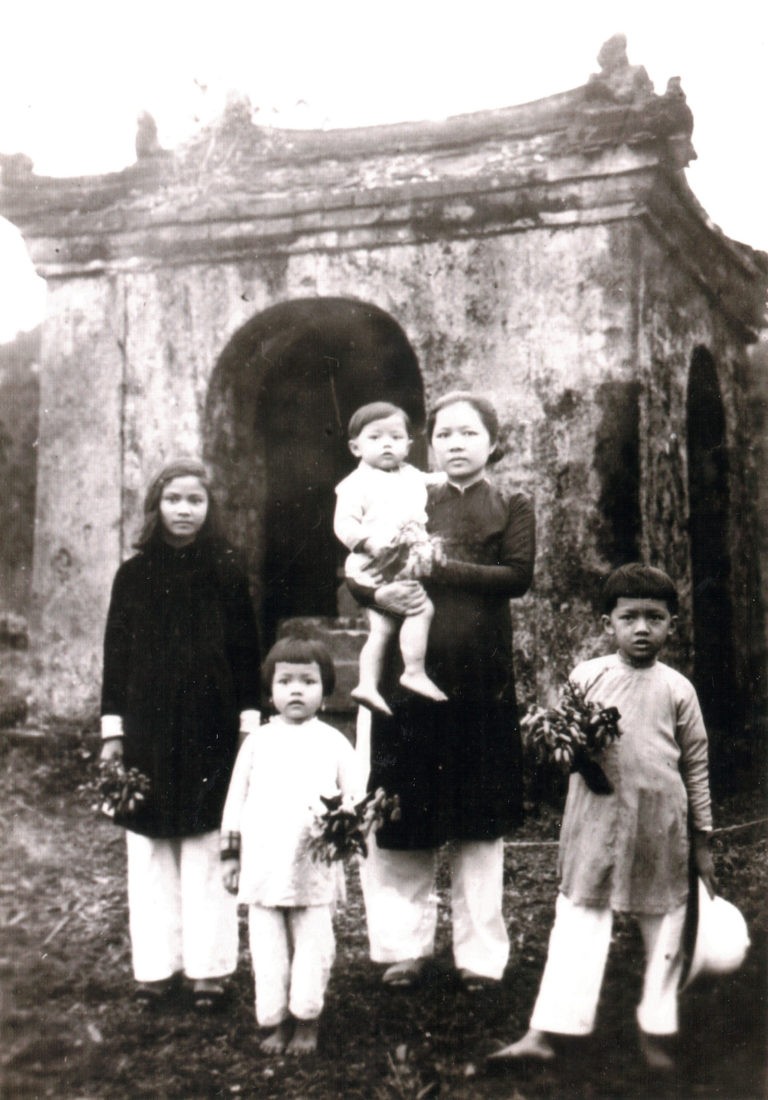
Cardinal François-Xavier Nguyễn Văn Thuận was born on April 17, 1928 in Phú Cam in the Archdiocese of Huê, in Central Vietnam. His parents were Nguyên Van Am and Elisabeth Ngo Thi Hiep, daughter of Ngo Dinh Kha. He was the second of nine children; four brothers and five sisters.
Descendant of a family line with a long Catholic history, which included many martyrs among its members, Cardinal Văn Thuận’s ancestors suffered for their faith during the time of Christian persecution from 1698 to 1885.
Raised in a profound Christian household, he received the precepts for an exemplary and holy life from his mother, Elisabeth. Every evening, she would recite various biblical accounts to him, speak of the lives of the Vietnamese martyrs (in particular, the martyrs that belonged to their family line), and describe the lives of the saints, especially that of Saint Therese of the Child Jesus.
She taught him to love others and to forgive always and everyone, at the same time instilling in him a profound love for his homeland, Vietnam.
At the age of thirteen, he entered into the Minor Seminary of An Ninh in Huê. Afterwards he continued his studies at the Major Seminary of Phú Xuân in the same city.
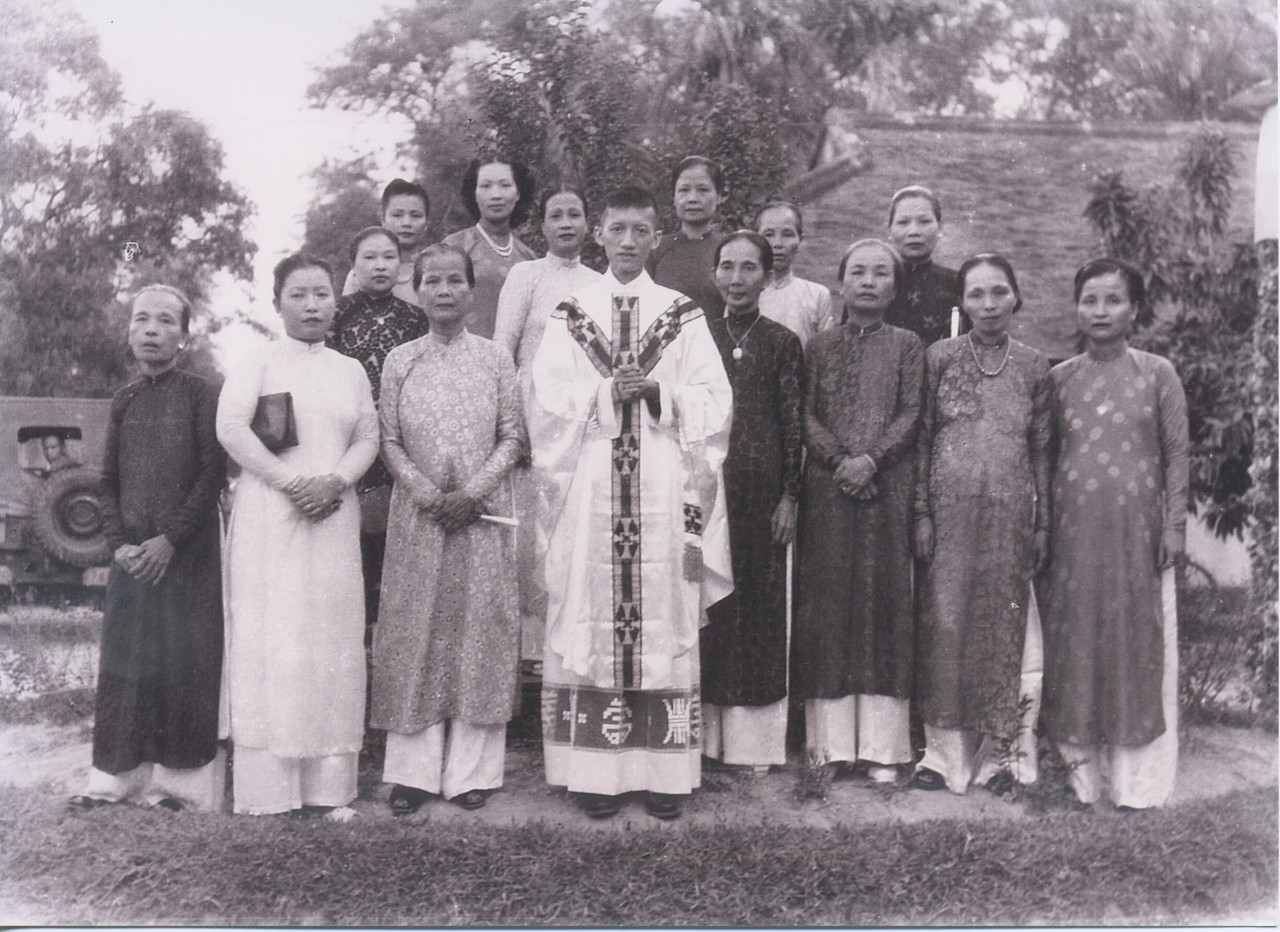
He was ordained a priest on June 11, 1953.
After his priestly ordination, he carried out his pastoral ministry in some parishes of Huê and, from 1956 to 1959, he was sent to Rome to study at the Faculty of Canon Law in the Pontifical Urbaniana University.
He finished his studies with a thesis on the subject of “Military Chaplains According to Canon Law”, for which he received highest approval (Summa cum Laude).
During his stay in Rome, he was granted the opportunity to participate in a Pontifical Audience with Pius XII, along with his maternal uncle, His Excellency Pierre Marie Ngo Dinh Thus, Bishop of Vinh Long in Vietnam.
Upon his return to Vietnam, he was nominated Professor; later, Rector of the Minor Seminary Hoan Thien from 1959 to 1967; finally, he was designated as Vicar General of the Archdiocese of Huê from 1964 to 1967.
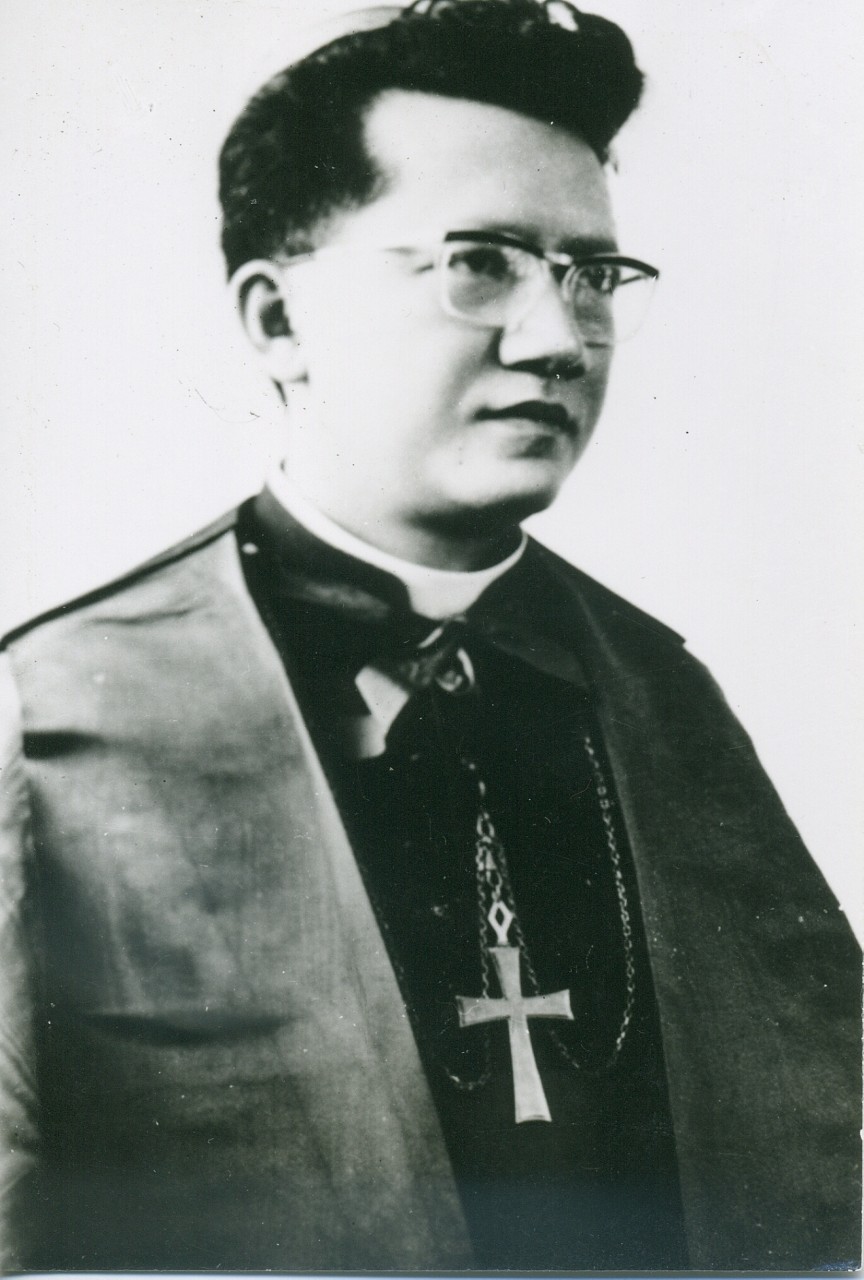
On April 13, 1967, Pope Paul VI nominated him as successor of Bishop Raymond Paul Piquet, a missionary of Paris Foreign Missions Society. Bishop Van Thuân then becomes the first Vietnamese Bishop of Nha Trang.
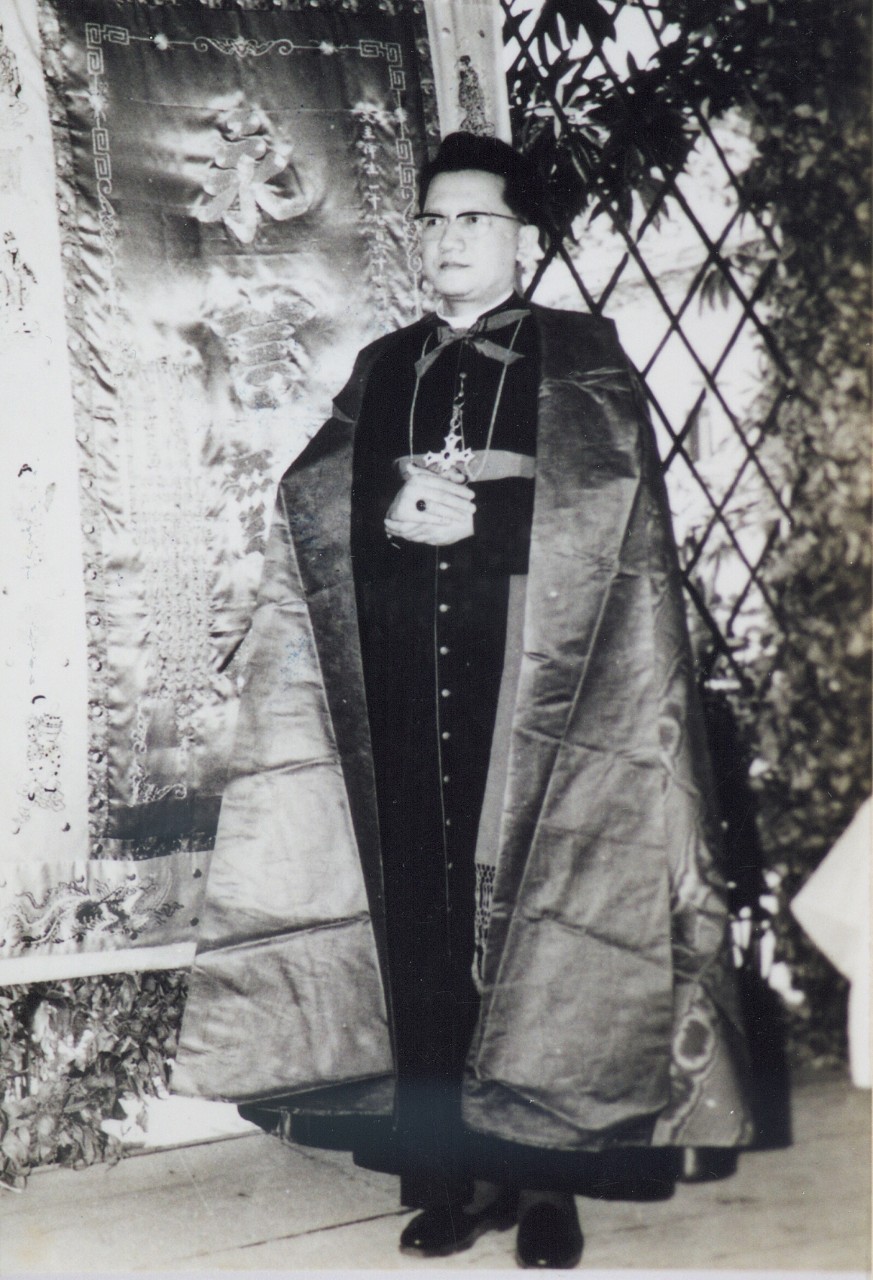
His Episcopal ordination took place on June 24, 1967 in Huê, presided over by His Excellency, Archbishop Angelo Palmas, the Apostolic Delegate in Saigon for Vietnam, Laos and Cambodia.
The episcopal motto chosen by the new Bishop is “Gaudium et Spes” (Joy and Hope), the title of the Pastoral Constitution on the Church in the Modern World of the Second Vatican Council.
On July 10, 1967, he took possession of the Diocese of Nha Trang and, for a period of eight years, sought to develop its pastoral life before the oncoming of difficult times.
The heart of his apostolic and pastoral activities was the formation of diocesan personnel: during his pastoral service, the number of seminarians in the Major Seminary increased from 42 to 147; the number of seminarians present in the four minor seminaries was augmented from 200 to 500; he organized educational courses and permanent formation for priests in the provinces of Central Vietnam; through the active collaboration of ecclesial bodies such as “Justice and Peace”, the Cursillo Movement, the Focolare Movement and Scouts, he developed and formed their cadres, gathering and involving young people, the laity, and parish pastoral councils; he also founded the religious communities of La Vang and La Speranza.
To provide solid pastoral guidance for the Diocese of Nha Trang, he published six pastoral letters: Keep watch and pray (Vigilate et orate, 1968); Reawaken to the Faith, Advance in Peace (1969); Justice and Peace (1970); Christ’s Mission is Our Mission (1971); On the occasion of the Anniversary of the Foundation of the Diocese of Nha Trang (1971); The Holy Year: Renewal and Reconciliation (1973).
He held various positions within the Bishops’ Conference of South Vietnam, such as:
Chairman of the Committees for Justice and Peace, for Social Communications, and for Development;
Director of the Corev Organization (Committee for the Reconstruction of Vietnam), which worked on behalf of those migrating from warzones to nationalistic regions;
Founder member of Radio Veritas in Manila, Philippines, and of the Asian Bishops’ Conference.
He participated numerous times in Meetings of the Federation of Asian Bishops’ Conferences (F.A.B.C.);
Consultor to the Pontifical Council for the Laity from 1971 to 1975; Consultor, and later Member, of the Congregation for the Evangelization of Peoples;
Member of the Congregation for Divine Worship and the Discipline of the Sacraments.
As Consultor to the Pontifical Council for the Laity, he had the opportunity to meet, on numerous occasions, the then-Archbishop of Cracow and, later, Pope John Paul II, with whom he had discussed intensely various issues related to the life of the faithful under the communist regime in Poland.
On 13 April 1975, Paul VI appointed him Titular Archbishop of Vadesi and Coadjutor Archbishop of Saigon (now Ho Chi Minh City). About four months later, on 15 August 1975, he was arrested because he was considered politically dangerous.
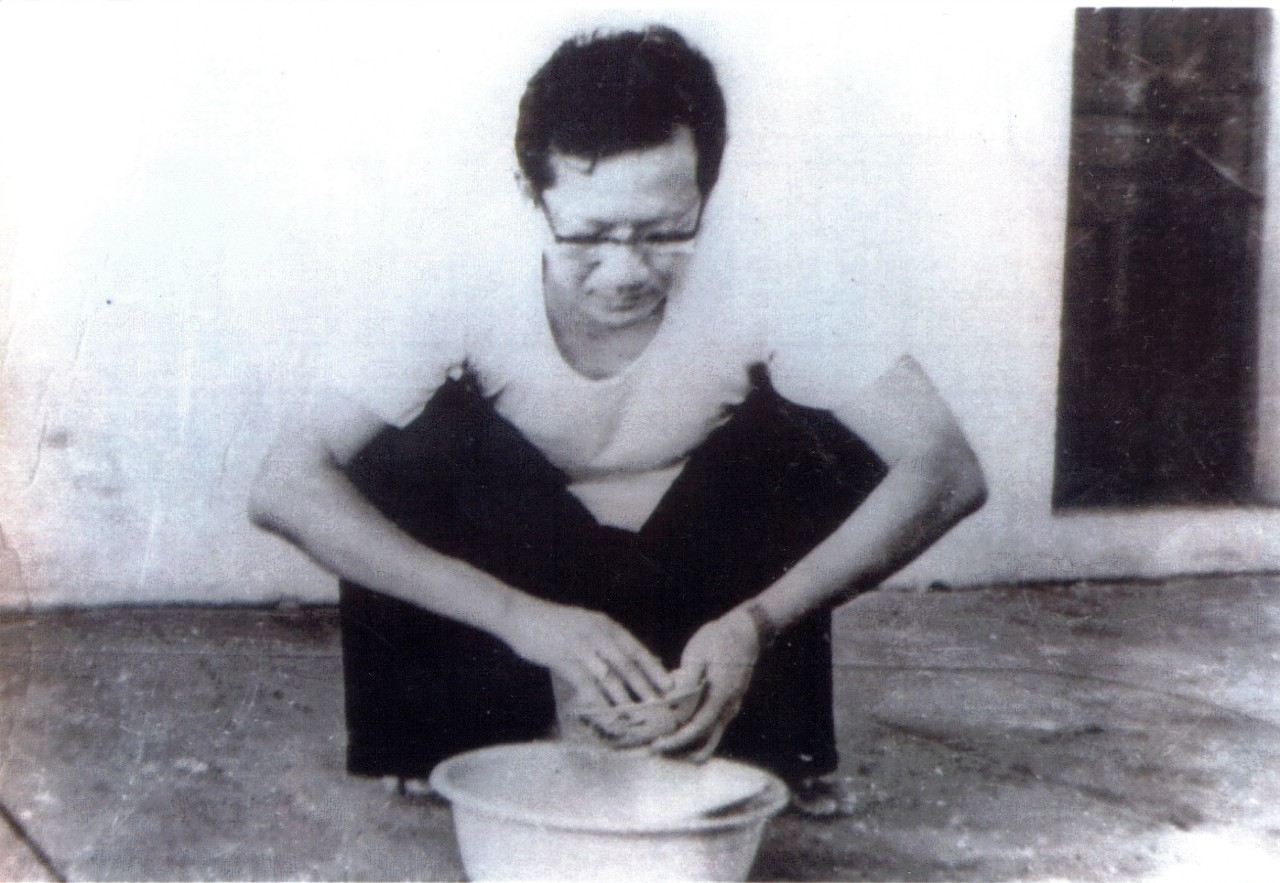
His imprisonment, without trial or sentence, lasted thirteen years, nine of which were spent in solitary confinement and four in various 're-education' camps.
Faithful to God, the Gospel, and the Church, he turned his jailers into good friends and transmitted to the other resigned prisoners the “gaudium et spes” that always flowed from the depths of his heart.
During his imprisonment, he managed to have the faithful send him wine in a small bottle with a label attached that read, “Medicine for stomach ache,” and some hosts hidden in a torch to protect them from moisture, celebrating Holy Mass in the palm of his hand, with three drops of wine and one drop of water. He lived in the presence of Jesus, whom he kept in his shirt pocket.
Released on 21 November 1988, he was expelled from Vietnam in 1991, choosing Rome as his place of exile. In 1992, he was appointed a member of the International Catholic Migration Commission based in Geneva, in 1994 he was appointed Vice-President of the Pontifical Council for Justice and Peace, and in 1998 he became its President.
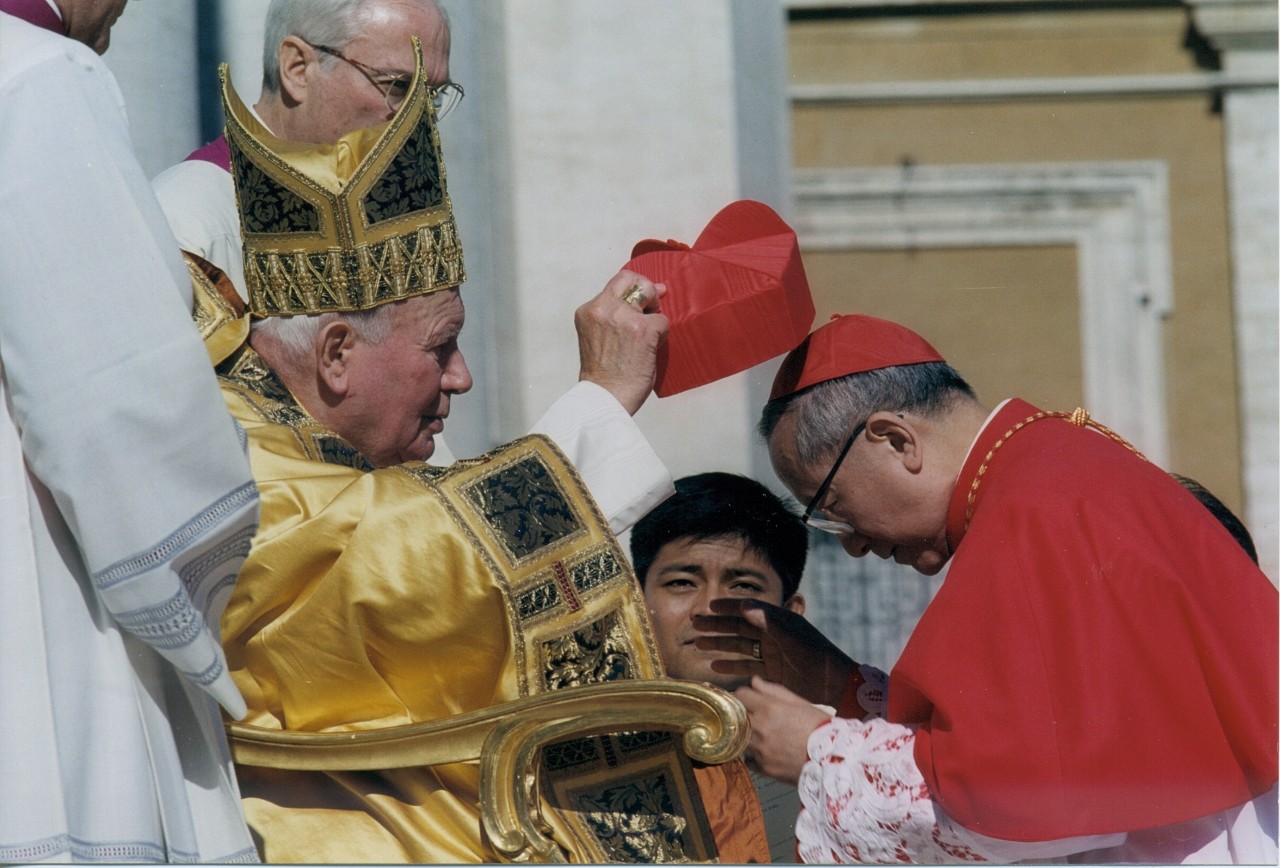
On 21 February 2001, he was created Cardinal. With joy and hope, he spread the Christian message of reconciliation and peace through his travels, writings, interviews, conferences, homilies, and spiritual exercises, including those for the Roman Curia from 12 to 18 March 2000.
Struck by cancer, he abandoned himself filial to God's will, with trust and patience, conforming himself ever more closely to Christ Crucified. He died in Rome on 16 September 2002.
Cardinal's history over the years
On the 23rd of April 1975, Pope Paul VI nominated him Coadjutor, with the right of succession, of the Archdiocese of Saigon (now: Ho Chi Minh City, Vietnam), raising him to the dignity of Titular Archbishop of Vadesi. The communist authorities of Saigon, however, did not permit him to remain in the city. On the Solemnity of the Assumption of the Blessed Virgin Mary, 15th of August 1975, he was arrested and transferred to Nha Trang, to be imprisoned in Cay Vong. Then, he was transferred to the Prison of the Security Forces in the city of Hanoi in North Vietnam. Sometime later, along with 250 other prisoners, he was relocated to the Re-education Camp of Vinh Quang (Vinh Phú). He was placed under house arrest at Giang Xâ, in the Province of Son Tay. During the thirteen years of his imprisonment, of which 9 years were spent in solitude, he wrote his spiritual will, “The Road of Hope”, directed towards the Vietnamese faithful living in the Homeland and in diaspora.
On the 24th of November 1994, Pope John Paul II nominated him as Vice-President of the Pontifical Council for Justice and Peace. From the 24th of June 1998 until 2002, he was President of the same Council, in this way giving a decisive impulse for the deepening and diffusion of the Social Doctrine of the Church.
After his imprisonment, he underwent seven surgeries and was three times in danger of death. He underwent his last surgery on May 8, 2002 at the National Institute for the Study and Treatment of Tumours (Istituto Nazionale per lo Studio e la Cura dei Tumori) in Milan, Italy. Upon returning to Rome for convalescence, his health deteriorated and, on the 5th of June 2002, he was taken urgently to the Roman Agostino Gemelli Hospital of the Sacred Heart Catholic University, and later transferred to the Pius XI Nursing Home in the Eternal City to continue his treatment.
He was invited many times to different countries to preach spiritual retreats for priests and bishops, to hold conferences in various places such as the Cathedral of Paris during Lent, or in Mexico on the 5th of May 1998 for a group of over 50,000 young people. On May 11, 1996, he received a doctorate degree honoris causa from the University of New Orleans in Louisiana, USA. The Congregation for the Evangelization of Peoples entrusted him with the task of conducting apostolic visitations in various seminaries in Africa.
On the 24th of November 1994, Pope John Paul II nominated him as Vice-President of the Pontifical Council for Justice and Peace. From the 24th of June 1998 until 2002, he was President of the same Council, in this way giving a decisive impulse for the deepening and diffusion of the Social Doctrine of the Church.
After his imprisonment, he underwent seven surgeries and was three times in danger of death. He underwent his last surgery on May 8, 2002 at the National Institute for the Study and Treatment of Tumours (Istituto Nazionale per lo Studio e la Cura dei Tumori) in Milan, Italy. Upon returning to Rome for convalescence, his health deteriorated and, on the 5th of June 2002, he was taken urgently to the Roman Agostino Gemelli Hospital of the Sacred Heart Catholic University, and later transferred to the Pius XI Nursing Home in the Eternal City to continue his treatment.
He was invited many times to different countries to preach spiritual retreats for priests and bishops, to hold conferences in various places such as the Cathedral of Paris during Lent, or in Mexico on the 5th of May 1998 for a group of over 50,000 young people. On May 11, 1996, he received a doctorate degree honoris causa from the University of New Orleans in Louisiana, USA. The Congregation for the Evangelization of Peoples entrusted him with the task of conducting apostolic visitations in various seminaries in Africa.
Year 2000
In Lent of 2000, the Holy Father invited him to preach the spiritual retreat for the Roman Curia – the first retreat of the New Millennium. After a private audience with the Pope, who had given him a golden chalice, Cardinal François-Xavier Nguyên Van Thuân said that, “24 years ago, as I celebrated Mass with three drops of wine and a drop of water in the palm of my hand, I would never have expected that the Holy Father would offer me a golden chalice as a gift”.
During the Consistory held on February 21, 2001, the Holy Father John Paul II created him Cardinal of the Roman Church, assigning him the Diaconia of Santa Maria della Scala, a Roman Church whose care was entrusted in 1597 to the Discalced Carmelite Fathers.
Cardinal François-Xavier Nguyễn Văn Thuận passed away in Rome on the 16th of September 2002
The portal cardinalvanthuan.va uses technical or similar cookies to make navigation easier and ensure the proper use of services, as well as third-party technical and analytics cookies. By closing this banner, you consent to the use of cookies.